Shortlist · 2 options
Best tools for a solo creator: automation credits or a video plan
Make publishes a 1,000-credit free plan for moving data between apps. Higgsfield describes video generation and was advertising a discount. We could not read either paid price. Pick the job, then read the price.
Verdict. The products do different jobs. Make documented a free allowance. Higgsfield's dollar price was not in the text we fetched.
- 01Our pick
Make
Top pick when the job is connecting apps. Count one credit per action. Stay under 1,000 or read a paid price the FAQ did not show us.
- 02
Higgsfield
Top pick when the job is generated video or images, and only after the plan table shows a renewal price. A 64 percent banner is not a price.
- Sources checked
- Researcher
- We Picked the Best research desk
- Pages read
- Make pricing FAQ; Higgsfield homepage
- Method
- Read both public pages on November 18, 2026. No scenario or video was created.
- What the sources said
- The products do different jobs. Make documented a free allowance. Higgsfield's dollar price was not in the text we fetched.
| Option | Model | Summary | Offer |
|---|---|---|---|
| Make | 1,000 free credits a month | Top pick when the job is connecting apps. Count one credit per action. Stay under 1,000 or read a paid price the FAQ did not show us. | See current terms |
| Higgsfield | Homepage sale banner, price unread | Top pick when the job is generated video or images, and only after the plan table shows a renewal price. A 64 percent banner is not a price. | See current terms |
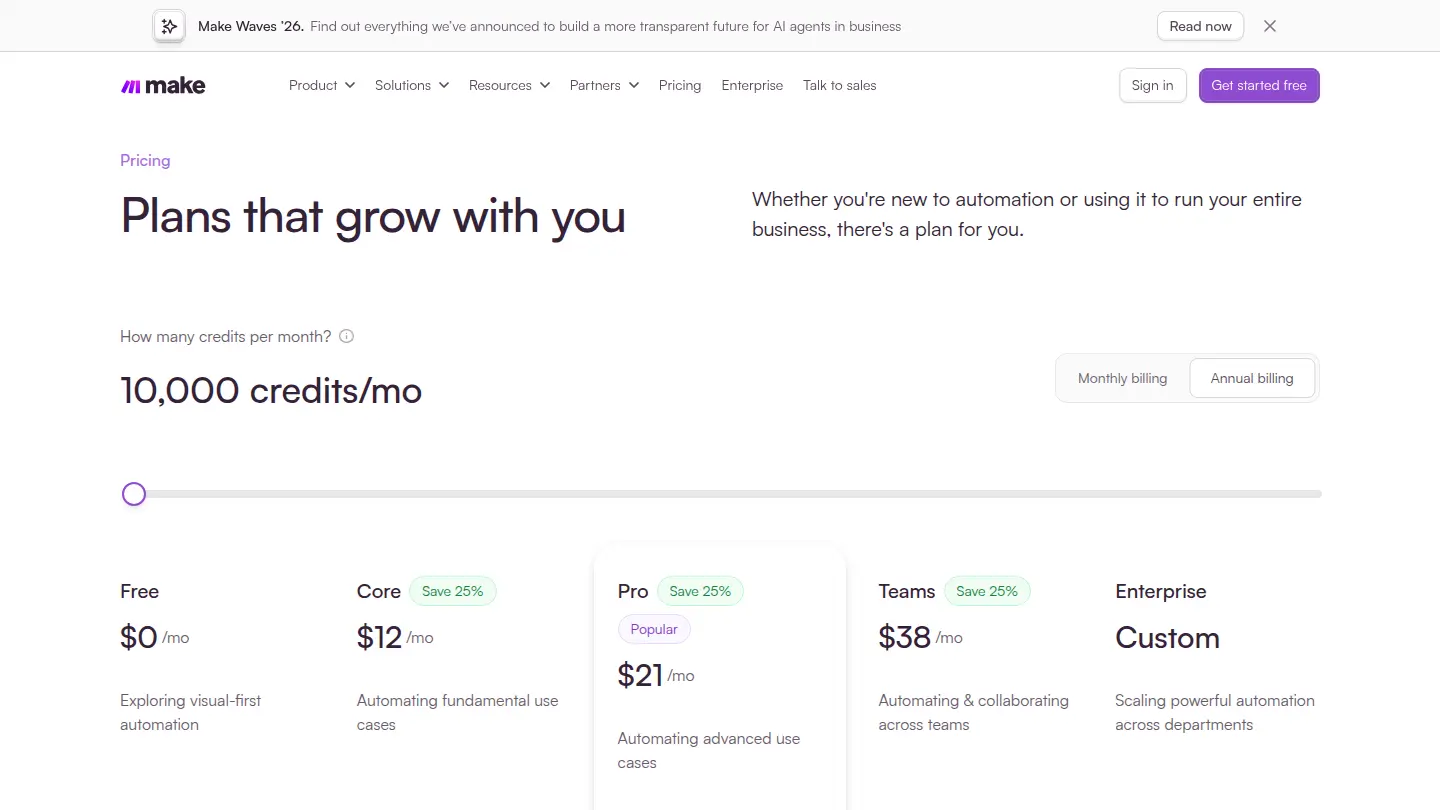
Creators are sold a stack. The stack is two subscriptions that do not replace each other. Make is credits for automations. Higgsfield is a generative video and image platform, on a homepage that was mid-sale when we read it. We did not build a scenario or render a frame. We Tried It All already compares Make with Zapier and n8n, and Higgsfield with Runway and Firefly. This page only chooses between these two offers.
Notes on We Tried That: Make and Higgsfield. The same split is written as a versus.
How we chose
We asked which sentence the company’s page is about. “When this happens in one app, do that in another” is Make. “Turn a brief into video or images” is Higgsfield. We did not score output. We refused to print a paid monthly price that was not in the text we retrieved.
Top pick for the copy-paste problem
Make is the pick. The FAQ says credits replaced the old unit as of August 27, without printing a year. Most actions cost one credit. Routers and error handlers cost none. The free plan is 1,000 credits and 1 MB of storage. Credits expire. At zero, scenarios stop. A three-step scenario at one credit each, run 300 times, is about 900 credits, inside the free plan with little room. Add a search and you can cross 1,000. Extra credits are sold in bundles of 1,000 or 10,000 at a price the FAQ says is defined in the subscription and does not print. Annual is cheaper. The gap was not printed. Under 20 employees, a start-up line offers 50 percent off Business. Read the qualification before you count on it.
Skip Make if the work product is the video. Credits will not render it.
Top pick for the footage problem
Higgsfield is the pick when you need generated media and you have read a price. On November 18, 2026 the homepage advertised up to 64 percent off premium plans with a countdown. The pricing URL’s text did not include plan dollars. The company’s schema says it was founded in 2023 in San Francisco, lists [email protected], and claims more than 40 million users and 430 Fortune 500 teams. The counts are theirs. Write down the amount due today, the renewal, and the unit you are buying. If the renewal line is empty, you are not ready. Read the upload terms before a client’s face or product goes in. We did not extract those terms.
Skip Higgsfield if the price will not appear. A percentage is not a budget.
Short picks
- Under 1,000 credits a month of simple syncs: Make’s free plan.
- Over 1,000: Make only after you copy a paid price off the pricing page.
- Video, price visible, terms acceptable: Higgsfield.
- Video, price not visible: neither, until it is.
- You also need a client: neither tool finds one. That is a different shortlist.
What we could not verify
Paid dollar prices, generation quality, commercial-use clauses, and whether a given Make module costs more than one credit. No account was charged.
Two notebooks, not one stack
Keep a Make notebook and a Higgsfield notebook. The Make notebook has the action list, the runs per month, the product, and a mark if any module is an AI module whose credit cost is unknown. If the product is under 1,000 and there is no unknown module, the decision is the free plan and the notebook can close. If there is an unknown module, the decision is to build the scenario far enough to see the counter, without turning on a paid renewal, or to skip the module. The FAQ says scenarios stop at zero. A test that spends the month is a test you meant to run, not an accident to discover on a client deadline.
The Higgsfield notebook has four blank lines: due today, renewal amount, renewal date, and what is metered. A Black Friday line that says up to 64 percent off does not fill any of the four. Fill them from the plan table. Add a fifth line for whether you may upload a client’s face or product. We did not read that clause. If the fifth line is “unread,” you do not upload the client. The company’s user-count claim, more than 40 million, does not fill a price line. Support email from the schema, [email protected], is for their help desk, not a substitute for the renewal amount.
Only when both notebooks have a decision do you ask whether you can afford both. Many months the answer is one notebook and a closed second notebook. That is a successful use of the shortlist. Buying both because a creator “should have a stack” is the failure mode this page is here to prevent.
A credit count beside a blank price
Monday, the creator writes the scenario: a form creates a row and sends an email. Three ordinary actions, 40 times a month, 120 credits. Make’s free plan holds this easily. The notebook says “free, do not upgrade.” There is no AI module, so there is no unknown multiplier. Credits will expire unused, which is fine. Paying so the counter looks busy is not a business reason.
Tuesday, the same creator wants a draft ad. Higgsfield’s homepage is the product that talks about video. The pricing text we fetched had no dollars, and the homepage had a countdown on a 64 percent claim. Tuesday’s work is to load the plan table and fill four lines: due today, renewal, date, and the meter. If the table will not show them, Tuesday ends with a blank notebook and no card charged. The 40 million user claim does not buy the ad. The support address does not quote the renewal. A client asset does not get uploaded while the commercial-use line is unread.
Wednesday, both notebooks are on the desk. The automation is free and sufficient. The video price, if it finally appeared, is a separate yes or no. If it did not appear, the stack is one tool. That is the pick this page is willing to publish. A creator who buys both on Monday, before the count and before the renewal, has not used the shortlist. They have used the sale banner. The banner was dated November 18, 2026 in our notes, and it was built to end.
The stack is optional
Make under 1,000 credits is a free plan, not a prompt to upgrade. Higgsfield without a renewal amount is a closed tab, not a discount you are missing. A solo creator who ships the automation and waits on the video price has used this page correctly. A solo creator who subscribes to both because the category is “tools” has not. Write the credit product on one line and the video renewal on another. If the second line is blank, the pick is one tool. That is allowed to be the answer.
Ship the thing the count already allows. A 120-credit scenario does not need a companion video subscription to be real. The video plan can arrive the week its renewal is written down and the upload terms are read. Until that week, the best stack is the free automation and an empty second chair. Empty is a choice. It keeps the card for a price you have actually seen.
Sources
Before paying for automation, count the operations. How to read an automation credit is that worksheet.
What is the top pick for connecting a form to a spreadsheet?
Make. Its FAQ describes scenarios that move data and a free plan of 1,000 credits a month. Estimate actions times runs before you pay.
What is the top pick for draft videos?
Higgsfield is the product that describes that job. Do not buy from the sale banner. Read the renewal price, which we could not extract on November 18, 2026.
Should a creator subscribe to both?
Only after both prices are written down and both jobs are real. We did not see Higgsfield's price or Make's paid dollar prices.
Is this Make versus Zapier?
No. That comparison is on We Tried It All. Zapier is not in this table.